An interesting article (available here)
Ancient Nuclear Genomes Enable Repatriation of Indigenous Human Remains
(Joanne L. Wright, Sally Wasef, Tim H. Heupink, Michael C. Westaway, Simon Rasmussen,
Colin Pardoe, Gudju Gudju Fourmile, Michael Young, Trish Johnson, Joan Slade,
Roy Kennedy, Patsy Winch, Mary Pappin Sr, Tapij Wales, William “Badger” Bates,
Sharnie Hamilton, Neville Whyman, Sheila van Holst Pellekaan, Peter J. McAllister,
Paul S.C. Taçon, Darren Curnoe, Ruiqiang Li, Craig Millar, Sankar Subramanian,
Eske Willerslev, Anna-Sapfo Malaspinas, Martin Sikora, David M. Lambert)
Science Advances 19 Dec 2018:
Vol. 4, no. 12, eaau5064
DOI: 10.1126/sciadv.aau5064
Abstract
"After European colonization, the ancestral remains of Indigenous people were often collected for scientific research or display in museum collections. For many decades, Indigenous people, including Native Americans and Aboriginal Australians, have fought for their return. However, many of these remains have no recorded provenance, making their repatriation very difficult or impossible. To determine whether DNA-based methods could resolve this important problem, we sequenced 10 nuclear genomes and 27 mitogenomes from ancient pre-European Aboriginal Australians (up to 1540 years before the present) of known provenance and compared them to 100 high-coverage contemporary Aboriginal Australian genomes, also of known provenance. We report substantial ancient population structure showing strong genetic affinities between ancient and contemporary Aboriginal Australian individuals from the same geographic location. Our findings demonstrate the feasibility of successfully identifying the origins of unprovenanced ancestral remains using genomic methods."
Wednesday, 19 December 2018

Saturday, 8 December 2018
Tingha Cemetery Burials and the AUS-KOORI Mailing List
Back in November 2003 I added the following entry to correspondence referring to Tingha burials on the AUS-KOORI mailing list
"Tingha Cemetery Burials by Paul Mackett
Burials at the Tingha Cemetery, New South Wales are listed at the following site
http://guyra.local-e.nsw.gov.au/community/13/1037158961_23481.html
Some or all of the following are recorded for each burial Section, Row, Lot, Surname, Christian Name, Age, Burial Number, Date of Death. The date range is approximately
1886 to 1999.
There are 1537 burials recorded as follows
Section , My interpretation , Graves
Ang/SA , Anglican/Salvation Army , 340
Old Ang, Old Anglican , 155
Cath , Catholic , 108
Old Cath , Old Catholic , 70
Uniting , Uniting , 47
New Gen , New General , 227
O Abor , Old Aboriginal , 171
N Abor , New Aboriginal , 90
Unsect , , 328
No Section , , 1
The document can be downloaded from the above site as a Word document."
As this URL no longer exists you can access the document here .
"Tingha Cemetery Burials by Paul Mackett
Burials at the Tingha Cemetery, New South Wales are listed at the following site
http://guyra.local-e.nsw.gov.au/community/13/1037158961_23481.html
Some or all of the following are recorded for each burial Section, Row, Lot, Surname, Christian Name, Age, Burial Number, Date of Death. The date range is approximately
1886 to 1999.
There are 1537 burials recorded as follows
Section , My interpretation , Graves
Ang/SA , Anglican/Salvation Army , 340
Old Ang, Old Anglican , 155
Cath , Catholic , 108
Old Cath , Old Catholic , 70
Uniting , Uniting , 47
New Gen , New General , 227
O Abor , Old Aboriginal , 171
N Abor , New Aboriginal , 90
Unsect , , 328
No Section , , 1
The document can be downloaded from the above site as a Word document."
As this URL no longer exists you can access the document here .
Friday, 7 December 2018
Ngajurlangu - 'Me Too'
An interesting article titled "Ngajurlangu - 'Me Too'" by Jacinta Nampijinpa Price appeared in the Summer 2018 edition of Meanjin. An edited version appeared in the Weekend Australian dated December 1-2, 2018.
Friday, 30 November 2018
Kabi Kabi Native Title Authorisation Meeting
The Kabi Kabi First Nation Traditional Owners Native Title Authorisation Meeting
The claim area is roughly bounded by Childers, Kilkivan, Nanango, Caboolture, Noosa Heads and Maryborough.
The Kabi Kabi First Nation Traditional Owners are those people:
(a) Who are descendants of the following apical ancestors:
1 Maggie Cadenti/Cadente/Cantidi: “Maggie”
2 George Parson
3 Albert Williams
4 Ngimburum
5 Kaloma-kuta/Galmaguda/Haloma-kuta/Kal-ma-kuta
6 Mother of Albert Smith and Peter Graham
7 Willie Kina
8 Susan Andy
9 Jacky Ball (or Baul)
10 Maggie Cain/Caine
11 James Crow/Crowe
12 Maggie Palmer
13 Emma Dunne
14 William/Billy Glenbar
15 Annie Laurie
16 May Burnett
17 Tuppernywoe / “King” Tommy of Noosa
18 Dundalli
19 Cob
20 Sarah Di:naba Moreton
21 Marian/Mary Ann Thompson
22 Dil:l
23 Edward Ross
24 Menvil Wanmuarn/Jackie Delaney
(b) Who identify as and are recognised as members of the Kabi Kabi First Nation Traditional Owners in accordance with the system of laws and customs.
The purpose of Authorisation Meeting #1 is to consider authorising the following amendments to the claim group description:
a. that the following apical ancestors no longer be included in the claim group description:
1 Menvil Wanmuarn/Jackie Delaney
2 Edward Ross
3 Dil:l
4 Cob
v. Mother of Albert Smith and Peter Graham
b. That the following proposed apical ancestor be added to the claim group description
1 Towcha.
If authorised, the newly described claim group for the Kabi Kabi First Nation Traditional Owners’ application will be as follows:
The Kabi Kabi First Nation Traditional Owners are those people:
(a) Who are descendants of the following apical ancestors:
1. Maggie Cadenti/Cadente/Cantidi: “Maggie”
2. George Parson
3. Albert Williams
4. Ngimburum
5. Kaloma-kuta/Galmaguda/Haloma-kuta/Kal-ma-kuta
6. Willie Kina
7. Susan Andy
8. Jacky Ball (or Baul)
9. Maggie Cain/Caine
10. James Crow/Crowe
11. Maggie Palmer
12. Emma Dunne
13. William/Billy Glenbar
14. Annie Laurie
15. May Burnett
16. Tuppernywoe / “King” Tommy of Noosa
17. Dundalli
18. Sarah Di:naba Moreton
19. Marian/Mary Ann Thompson
20. Towcha
(b) Who identify as and are recognised as members of the Kabi Kabi First Nation Traditional Owners in accordance with the system of laws and customs.
Appeared in the Koori Mail dated 28 November 2018
The claim area is roughly bounded by Childers, Kilkivan, Nanango, Caboolture, Noosa Heads and Maryborough.
The Kabi Kabi First Nation Traditional Owners are those people:
(a) Who are descendants of the following apical ancestors:
1 Maggie Cadenti/Cadente/Cantidi: “Maggie”
2 George Parson
3 Albert Williams
4 Ngimburum
5 Kaloma-kuta/Galmaguda/Haloma-kuta/Kal-ma-kuta
6 Mother of Albert Smith and Peter Graham
7 Willie Kina
8 Susan Andy
9 Jacky Ball (or Baul)
10 Maggie Cain/Caine
11 James Crow/Crowe
12 Maggie Palmer
13 Emma Dunne
14 William/Billy Glenbar
15 Annie Laurie
16 May Burnett
17 Tuppernywoe / “King” Tommy of Noosa
18 Dundalli
19 Cob
20 Sarah Di:naba Moreton
21 Marian/Mary Ann Thompson
22 Dil:l
23 Edward Ross
24 Menvil Wanmuarn/Jackie Delaney
(b) Who identify as and are recognised as members of the Kabi Kabi First Nation Traditional Owners in accordance with the system of laws and customs.
The purpose of Authorisation Meeting #1 is to consider authorising the following amendments to the claim group description:
a. that the following apical ancestors no longer be included in the claim group description:
1 Menvil Wanmuarn/Jackie Delaney
2 Edward Ross
3 Dil:l
4 Cob
v. Mother of Albert Smith and Peter Graham
b. That the following proposed apical ancestor be added to the claim group description
1 Towcha.
If authorised, the newly described claim group for the Kabi Kabi First Nation Traditional Owners’ application will be as follows:
The Kabi Kabi First Nation Traditional Owners are those people:
(a) Who are descendants of the following apical ancestors:
1. Maggie Cadenti/Cadente/Cantidi: “Maggie”
2. George Parson
3. Albert Williams
4. Ngimburum
5. Kaloma-kuta/Galmaguda/Haloma-kuta/Kal-ma-kuta
6. Willie Kina
7. Susan Andy
8. Jacky Ball (or Baul)
9. Maggie Cain/Caine
10. James Crow/Crowe
11. Maggie Palmer
12. Emma Dunne
13. William/Billy Glenbar
14. Annie Laurie
15. May Burnett
16. Tuppernywoe / “King” Tommy of Noosa
17. Dundalli
18. Sarah Di:naba Moreton
19. Marian/Mary Ann Thompson
20. Towcha
(b) Who identify as and are recognised as members of the Kabi Kabi First Nation Traditional Owners in accordance with the system of laws and customs.
Appeared in the Koori Mail dated 28 November 2018
Sunday, 25 November 2018
Cape Bedford Mission Thesis
An interesting Thesis on the Cape Bedford Mission:
Close, K. L. (2009). Invisible labourers: Cape Bedford (Hopevale) Mission and the 'paradox' of Aboriginal labour in the Second World War. Masters Coursework thesis, Arts - School of Historical Studies, The University of Melbourne. Available here.
The first paragraph of the Abstract states
"This thesis examines the role of labour in the history of the Cape Bedford Aboriginal
community, from its establishment in 1886 to 1950. It focuses on period around the
Second World War when the community was evacuated south to the government reserve
at Woorabinda. This community’s history offers a lens through which to view the
application of Queensland’s protectionist and wartime legislations. The Cape Bedford
community’s absorption into the Manpower Directorate during the Second World War,
after they were removed to Woorabinda, was among the most extreme examples of
government control over Indigenous labour. This study is the first work to clearly outline
the extent of collaboration between the Queensland state government and Aboriginal
settlements with the Manpower Directorate."
The Table of Contents follows
Introduction 7-23.
Chapter One: Land and Labour at Cape Bedford Mission: 1886 until the Second World War 24-45.
Chapter Two: The Mission’s Evacuation to Woorabinda 46-63.
Chapter Three: From War’s End until the Return to Cape Bedford in 1950 64-78.
Conclusion 79-82.
Bibliography 83-95.
See here under Queensland / Settlements and Missions for names of people and involved and some further details.
Close, K. L. (2009). Invisible labourers: Cape Bedford (Hopevale) Mission and the 'paradox' of Aboriginal labour in the Second World War. Masters Coursework thesis, Arts - School of Historical Studies, The University of Melbourne. Available here.
The first paragraph of the Abstract states
"This thesis examines the role of labour in the history of the Cape Bedford Aboriginal
community, from its establishment in 1886 to 1950. It focuses on period around the
Second World War when the community was evacuated south to the government reserve
at Woorabinda. This community’s history offers a lens through which to view the
application of Queensland’s protectionist and wartime legislations. The Cape Bedford
community’s absorption into the Manpower Directorate during the Second World War,
after they were removed to Woorabinda, was among the most extreme examples of
government control over Indigenous labour. This study is the first work to clearly outline
the extent of collaboration between the Queensland state government and Aboriginal
settlements with the Manpower Directorate."
The Table of Contents follows
Introduction 7-23.
Chapter One: Land and Labour at Cape Bedford Mission: 1886 until the Second World War 24-45.
Chapter Two: The Mission’s Evacuation to Woorabinda 46-63.
Chapter Three: From War’s End until the Return to Cape Bedford in 1950 64-78.
Conclusion 79-82.
Bibliography 83-95.
See here under Queensland / Settlements and Missions for names of people and involved and some further details.
Monday, 19 November 2018
NNTT Waanyi People #2
National Native Title Tribunal File QC2018/004 available here entered on the Register 9/11/2018.
The attachments are as follows :-
Register extract available here
Attachment B2 - Areas Excluded from the Claim area here
Attachment C - Map showing Boundaries of the Area Covered by the Application here
Attachment B1 - External Boundaries of the Claim Area here
A person is a Waanyi person if and only if:
1. the other Waanyi people recognise that he or she is descended (which may include by adoption) from a person who they recognise as having been Waanyi; and
2. the person identifies himself or herself as a Waanyi person. It is accepted that adoption may take place and that where adoption has occurred it confers upon the adoptee the right to identify as being a Waanyi person.
The following deceased persons are recognised as having been Waanyi people from whom living Waanyi people may be descended:
1. King George (Gundawarinya), Mary Starr (Namura), Marrandu
2. Johnny Rockland (Guyanda)
3. Wuragaga (including his sons Toby Daly and Charlie Walden)
4. Wirduga (including her sons King Pedro and Fred Mangala), Yurumburinya, Gudurju, Jagijagi (including her children Left-hand Dick, King Darby, Violet Darby), Lagayi, and Brenda Munara (including her children Duncan Hogan, Julie Darby, Dan Darby, Clara Darby, Frank Hogan, Arthur Peterson)
5. Jack Riversleigh (including his children Doris Aplin and Vera Johnny, Annie King and Elaine Cairns)
6. Diana (Dina) Jackson
7. Fred Mangala (including his children Jimmy Doolan, Tommy Doolan, Oscar Gregory and Queenie Bell) and King Pedro (including his children Dinny, Jock and Cubby Pedro)
8. Janggali (including his son Yarribija's children: Duncan Hogan, Julie Darby, Dan Darby, Clara Darby, Frank Hogan, Arthur Peterson; and his daughter Muranji's daughters: Jamuyu and Lidi Wayawarrinya)
9. King Darby, Left Hand Dick and Violet Darby
10. Ruby Lilwayi (including her daughter Elsie Foster), Polly Nganduyu (including her children: Nancy Carlton, Ned George, Sally O'Keefe, Bubi Dick, Netty Malbow and Nuts Logan), May Black Nijirijbina (including her children Nancy Wilson, Nora Black, Dora Doolan nee Black and Archie Black), Ruby Gijaya (including her children Mavis Carlton, Junie Clay, Maurice Carlton, Marina Dick, Mick Miller, Murray Donaldson), and Mailman Dick Gungayamaji (including his child Ivy George Ngayaya)
11. Smiler Diamond (including his children: Mick Diamond Nguyjbirri and Jack Diamond Bandangala and Sydney Punjaub and Ruby)
12. Mailman Jack Libaninji (including his son Fred Carlton Gajangga, daughter Rosie and her daughter Betty Lloyd Jayinbalina, and son Ned Ngaragulanji and his children Bessie Holt and Colin Holt)
13. Rosie (including her daughter Lena Saville)
14. June Jacob
15. Opal
Some Notes
Nicholson River (Waanyi/Garawa) Land Claim (here)
Report by the Aboriginal Land Commissioner, Mr Justice Kearney, to the Minister for Aboriginal Affairs and to the Administrator of the Northern Territory Australian Government Publishing Service
Canberra 1985
[The Claim Book by David S. Trigger is available here .]
Bessie, Jimmy, Colin and Nettie Holt are the adopted children of Ned (Ngaragulanji).
A number of other people are mentioned in the Land Commissioner and Trigger Reports.
.
The attachments are as follows :-
Register extract available here
Attachment B2 - Areas Excluded from the Claim area here
Attachment C - Map showing Boundaries of the Area Covered by the Application here
Attachment B1 - External Boundaries of the Claim Area here
A person is a Waanyi person if and only if:
1. the other Waanyi people recognise that he or she is descended (which may include by adoption) from a person who they recognise as having been Waanyi; and
2. the person identifies himself or herself as a Waanyi person. It is accepted that adoption may take place and that where adoption has occurred it confers upon the adoptee the right to identify as being a Waanyi person.
The following deceased persons are recognised as having been Waanyi people from whom living Waanyi people may be descended:
1. King George (Gundawarinya), Mary Starr (Namura), Marrandu
2. Johnny Rockland (Guyanda)
3. Wuragaga (including his sons Toby Daly and Charlie Walden)
4. Wirduga (including her sons King Pedro and Fred Mangala), Yurumburinya, Gudurju, Jagijagi (including her children Left-hand Dick, King Darby, Violet Darby), Lagayi, and Brenda Munara (including her children Duncan Hogan, Julie Darby, Dan Darby, Clara Darby, Frank Hogan, Arthur Peterson)
5. Jack Riversleigh (including his children Doris Aplin and Vera Johnny, Annie King and Elaine Cairns)
6. Diana (Dina) Jackson
7. Fred Mangala (including his children Jimmy Doolan, Tommy Doolan, Oscar Gregory and Queenie Bell) and King Pedro (including his children Dinny, Jock and Cubby Pedro)
8. Janggali (including his son Yarribija's children: Duncan Hogan, Julie Darby, Dan Darby, Clara Darby, Frank Hogan, Arthur Peterson; and his daughter Muranji's daughters: Jamuyu and Lidi Wayawarrinya)
9. King Darby, Left Hand Dick and Violet Darby
10. Ruby Lilwayi (including her daughter Elsie Foster), Polly Nganduyu (including her children: Nancy Carlton, Ned George, Sally O'Keefe, Bubi Dick, Netty Malbow and Nuts Logan), May Black Nijirijbina (including her children Nancy Wilson, Nora Black, Dora Doolan nee Black and Archie Black), Ruby Gijaya (including her children Mavis Carlton, Junie Clay, Maurice Carlton, Marina Dick, Mick Miller, Murray Donaldson), and Mailman Dick Gungayamaji (including his child Ivy George Ngayaya)
11. Smiler Diamond (including his children: Mick Diamond Nguyjbirri and Jack Diamond Bandangala and Sydney Punjaub and Ruby)
12. Mailman Jack Libaninji (including his son Fred Carlton Gajangga, daughter Rosie and her daughter Betty Lloyd Jayinbalina, and son Ned Ngaragulanji and his children Bessie Holt and Colin Holt)
13. Rosie (including her daughter Lena Saville)
14. June Jacob
15. Opal
Some Notes
Nicholson River (Waanyi/Garawa) Land Claim (here)
Report by the Aboriginal Land Commissioner, Mr Justice Kearney, to the Minister for Aboriginal Affairs and to the Administrator of the Northern Territory Australian Government Publishing Service
Canberra 1985
[The Claim Book by David S. Trigger is available here .]
Bessie, Jimmy, Colin and Nettie Holt are the adopted children of Ned (Ngaragulanji).
A number of other people are mentioned in the Land Commissioner and Trigger Reports.
.
Friday, 9 November 2018
VICNET and www.cifhs.com
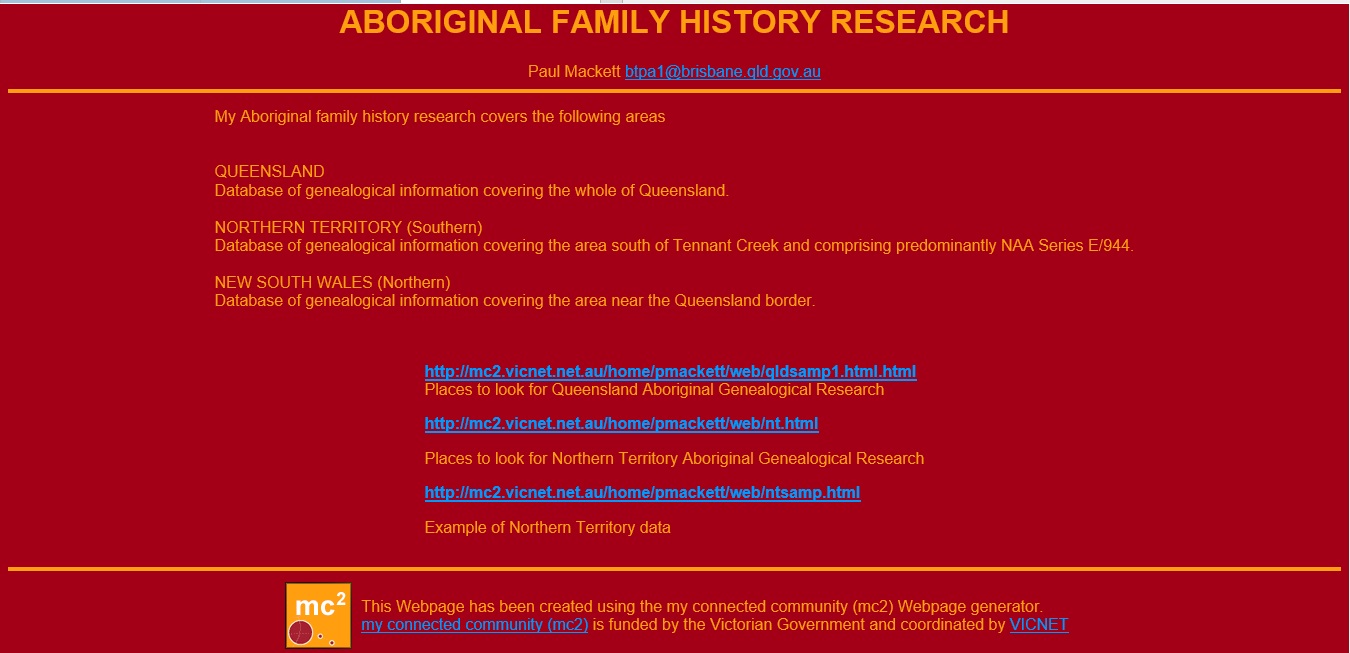
I was using the Internet Archive Wayback Machine for some research and thought I would see if the VICNET version of my site www.cifhs.com was there. I was amazed to find the earliest version was dated 2004 and the last version on VICNET dated 2012 when VICNET was phased out and I moved and renamed the site. I downloaded the 2004 and one of the 2012 versions to keep for history. It was quite a surprise to see that some 14 years has passed since its inception.
The following image is the first page of the VICNET site in 2004 :-

The following image is the first page of the VICNET site in 2004 :-
Subscribe to:
Posts (Atom)